Background
Wireless sensors are a popular choice for home automation and monitoring projects. The main disadvantage of wireless sensors is that they are often limited by their range and power consumption. After some experimentation with LoRa, I decided to design and build my own LoRa sensor board.
The main goals were:
- Low power consumption: multi-year battery life
- Long-range communication (open field > 1km)
- Programmable like an Arduino
- Simple but robust hardware, for multiple purposes
- Full firmware control without vendor lock-in
This project is a part of my Home Automation system, details can be found here
Hardware Design
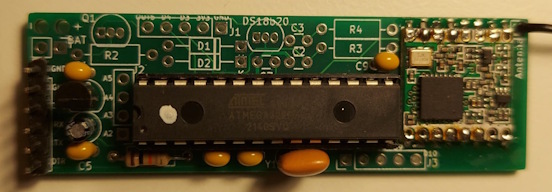
The sensor board was designed completely from scratch and focuses on efficiency, flexibility, and reliability.
Core components:
- ATmega328P microcontroller
- RFM95W LoRa transceiver
- Integrated temperature sensing
- Multiple switch / digital inputs
- Relay / SSR control outputs
- Power supply based on a single 18650 Li-Ion cell
The board is fully programmable and behaves like a standard Arduino Pro Mini, allowing rapid firmware development and easy integration with existing toolchains.
Ultra-Low Power Concept
Low power consumption was the central design constraint. Every part of the system was optimized to minimize standby current:
- Deep sleep by default
- Parts of the board can be automatically turned off to save power
- LoRa module fully powered down between transmissions
- Carefully tuned timing and voltage settings help save power
The measured sleep current is 5.3 µA.
Tested with a energy meter pulse counter, which is sending every 3 minutes the used energy, it took outdoor 3 years before the battery (3500mAh) was empty.
Actual battery life depends heavily on transmit interval, payload size, temperature, and battery aging. In real deployments, conservative software design is still required.
Typical Use Cases
This board is designed for locations where running cables is difficult or impractical:
- Remote temperature monitoring
- Remote door or window sensors
- Remote energy meter monitoring
- Post box monitoring
- Weather station monitoring
Because the firmware is fully programmable, the same hardware can be reused for very different applications.
Projects Based on This Board
I developed the following projects based on this board:
- Remote temperature monitoring
- Door or window status sensing
- Remote energy meter readings
- Mailbox monitoring
- Hot tub temperature monitoring
- Pool temperature monitoring
- Freezer temperature monitoring
- Weather station monitoring
- Testing gateway
The system does not rely on a specific cloud platform and can be integrated with any LoRa gateway or custom receiver.
The LoRa Gateway via USB
The network of LoRa sensors can be controlled and monitored remotely via the USB LoRa gateway. Which can be found in the following repository:
The LoRa2MQTT service can be found in the following repository:
Result
This project resulted in a compact, efficient, and flexible LoRa sensor that enables long-term autonomous operation in locations that are otherwise hard to monitor.
Its strengths are flexibility, low power consumption, and long wireless range, while the main engineering challenge remains finding the right balance between responsiveness and battery life.