Background
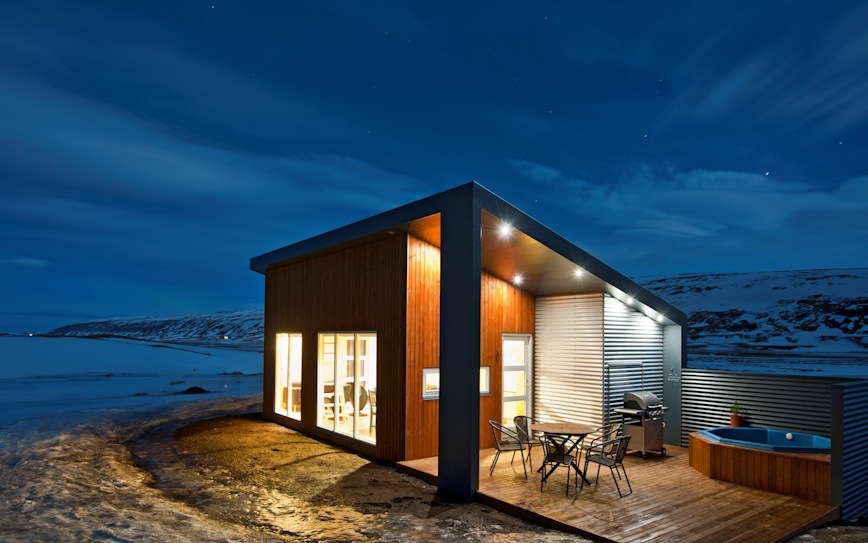
For many years, I wanted to design and build a low-energy, self-sufficient house with integrated home automation. Rather than relying on complex off-the-shelf smart home systems, the goal was to build a system focused on reliability, simplicity, and practical day-to-day use, without any dependency on cloud services.
From the architectural design phase onward, the automation system was developed alongside the house itself. Most sensors and devices are hard-wired to improve reliability, to reduce wireless dependencies, and to keep all cabling hidden within the building structure.
Key design principles:
- The house system must be able to function safely without home automation
- No dependency on cloud services or permanent internet connectivity — everything runs locally
- Simple and intuitive for daily family use
- Non-intrusive and distraction-free
The Home Automation System
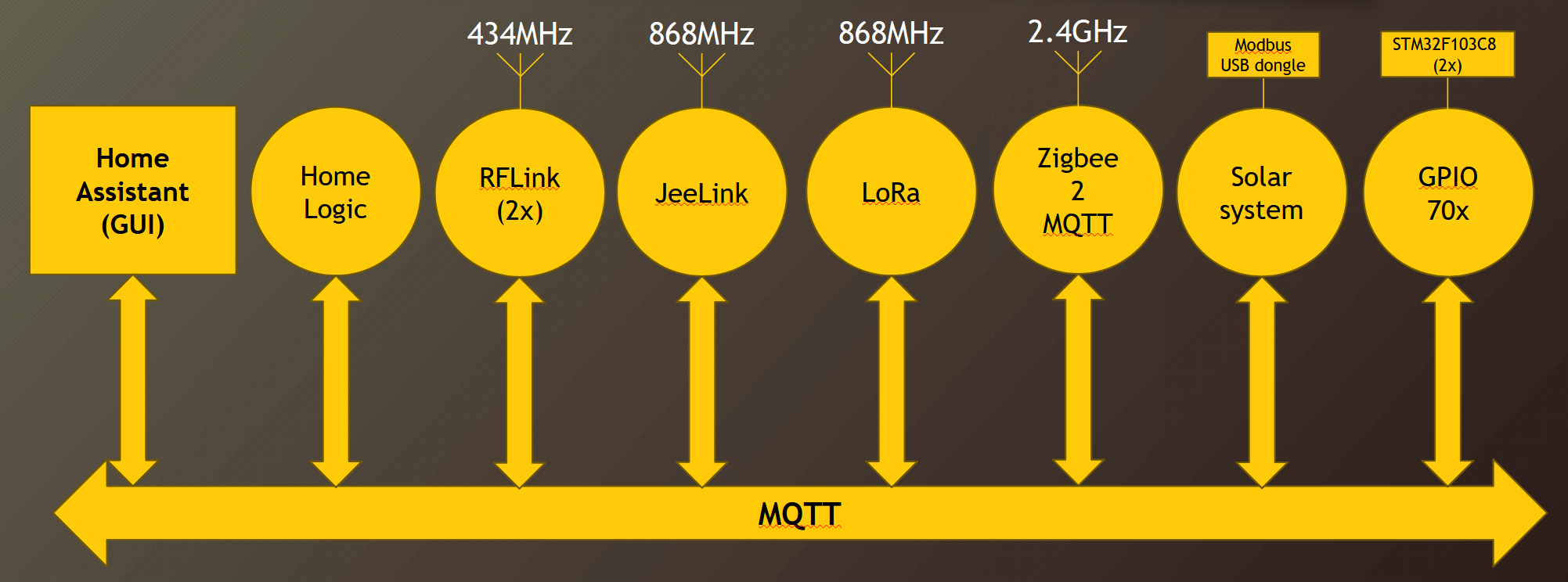
My home automation system is built around two core components: Home Assistant for the user interface and HomeLogic as the central automation engine. HomeLogic is an event-driven logic system that contains and executes all home automation logic.
Communication between Home Assistant and HomeLogic is handled through MQTT, which acts as the primary messaging layer.
Integration with external devices is provided by protocol- and device-specific gateway services. Multiple instances of certain services are deployed at different physical locations to improve radio coverage and system reliability.
System Architecture
The system runs across multiple Linux servers:
- Infrastructure + Home Assistant
- HomeLogic Engine
- I/O Server
- Outbuilding server
On these servers are runningHome Assistant and HomeLogic, including services that provide integration with external devices for the following technologies:
- RFLink (2×)
- JeeLink
- LoRa
- Zigbee
- ADL3000 (3-phase energy meter)
- Tesla
- GPIO controllers (2×)
This modular design isolates failures, simplifies debugging, and makes it easy to add new functionality without touching the core system.
Security & Alarm System
All windows, doors, and rooms — including the outbuilding — are equipped with sensors. The alarm supports several modes:
- Off
- Home
- Night
- Away
Modes are activated automatically using an algorithm based on presence, motion, and location of the mobile phones. But can also be manually activated. Smoke detectors integrate into the system and trigger a centralized alarm.
Additional context-aware logic improves usability:
- alerts if windows or doors stay open too long while it’s cold outside
- warnings when a roof window is open during rain or strong winds
- bathroom humidity notifications when ventilation is no longer needed

Heating Control logic
Floor and boiler heating is controlled by the Home Energy Management System (Home EMS):
Separate from the EMS, HomeLogic also ensures frost protection in:
- the workshop
- the shed
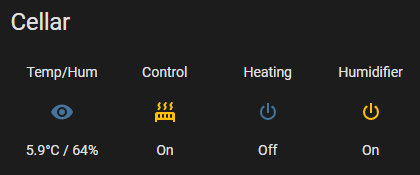
- the cellar
The cellar has its own system that maintains optimal temperature and humidity for winter fruit storage.
Weather Monitoring
A local weather station continuously measures:
- temperature
- humidity
- air pressure
- wind speed and direction
- rainfall
A forecasting algorithm analyzes trends and triggers early warnings for extreme conditions. All weather data is published to MQTT for use by other automations.
Water & Hydraulics
Hot Tub and Pool
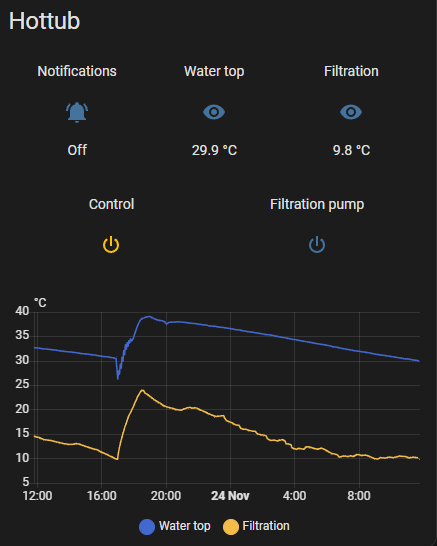
The system monitors temperature, filtration, and operating conditions. Automation includes:
- smart filtration to maintain water quality
- freeze protection for filtration system
- targeted warnings when needed
- hottub: automatic water mixing during heating for accurate temperature readings while heating up
Drinking Water System
Automation also manages the household water supply:
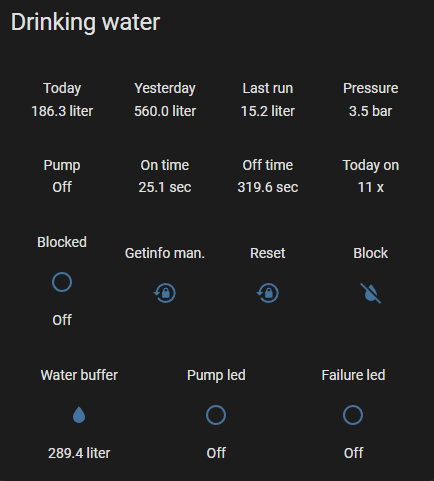
- pressure regulation through pump + pressure tank
- monitoring of water consumption
- detection when the pressure tank needs to be pressured or replaced
- alerts for unusually high water consumption
- pipe-burst protection through extreme-flow detection
This protects both the pump and the water system as a whole.
Home EMS
HomeLogic includes the Home EMS, a specialized subsystem focused on intelligent energy management.
The EMS’s core objectives are to maximize self-consumption of solar energy and minimize grid usage.
In short, the EMS performs:
- Monitoring of all energy sources and devices
- Priority-based control of devices (car charger, boiler, pool heater, etc.)
- Energy- and price-aware scheduling
- Heating optimization
- Battery management
- Phase balancing
More details about the EMS can be found in Home EMS
System Stability & Reliability
High uptime is ensured through several watchdog mechanisms:
- SystemWatch: monitors all services on all servers, restarting them if needed
- BoardMonitoring: checks temperatures, memory usage, and disk space on all servers
- ThreadWatch: ensures all HomeLogic threads are running; restarts HomeLogic if not
- BatteryCheck: daily summary of sensors when low battery
This greatly reduces manual maintenance and helps the system recover autonomously from failures.
Notifications & Remote Commands
All alerts and status updates are sent via Telegram.
If Home Assistant becomes unreachable, Telegram also acts as a fallback command interface, ensuring continuous control over critical systems.
Custom hardware and firmware
The system includes custom hardware components to meet the specific needs of the project:
- GPIO interface board to read the digital inputs and steer the relays
- LoRa Gateway to connect the LoRa sensors to the network
- LoRa pool heating steering board for SSR control and measuring temperatures
- LoRa Weather station hardware and firmware
- Universal Low-Power LoRa Sensor
Universal Low-Power LoRa Sensor
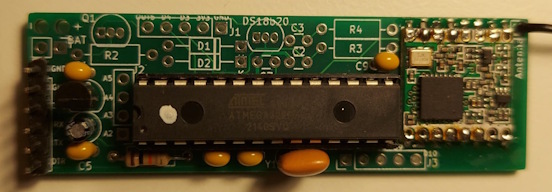
I developed a universal low-power LoRa sensor board featuring:
- ATmega328P microcontroller
- RFM95W LoRa radio
- Temperature sensing
- Switch inputs
- Relay / SSR control outputs
- 18650 Li-Ion battery power
- Fully programmable like a standard Arduino Pro Mini
With a power consumption of only 5.3µA, the board can operate for up to three years on a single battery charge under typical conditions.
These sensors provide remote monitoring and control in locations where wiring is impractical.
Detailed information can be found in Universal Low-Power LoRa Sensor.
An integrated and reliable Home Automation System
All components — from climate control and security to pool filtration, water pressure, energy management, and local weather monitoring — operate as a cohesive whole. By custom-built hardware and software, low-power sensors, watchdog mechanisms, and a robust MQTT infrastructure, the house functions as an integrated and reliable system.
Even in the event of a major failure, each subsystem can continue operating independently of the central automation system, ensuring that essential functions remain safe and reliable.